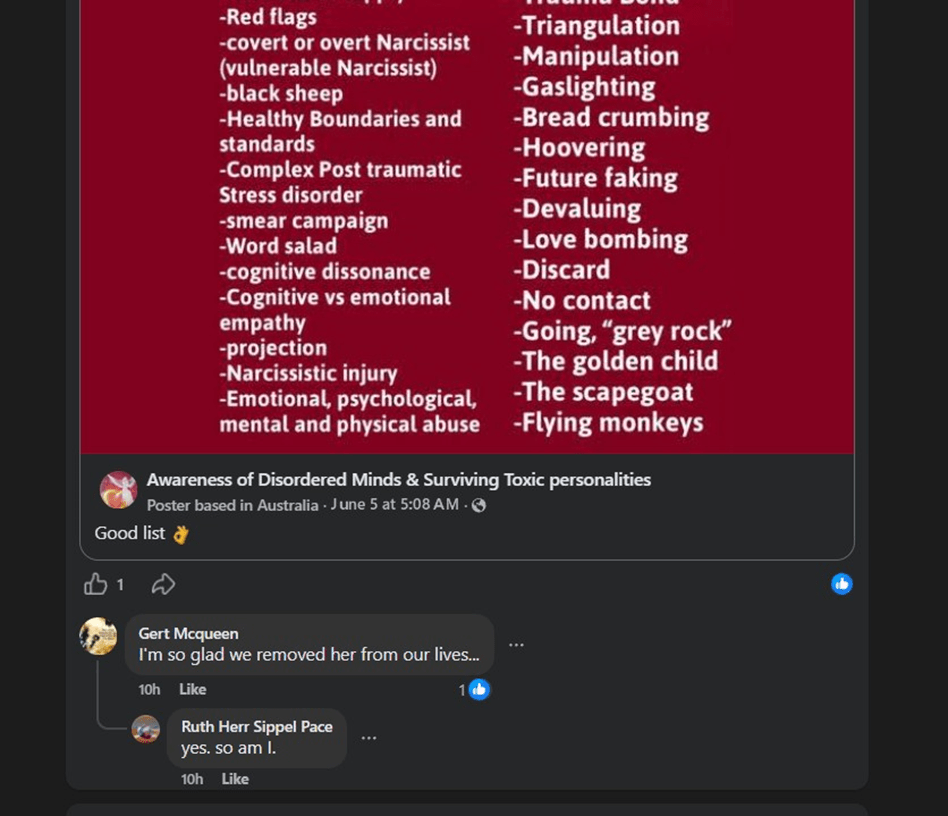
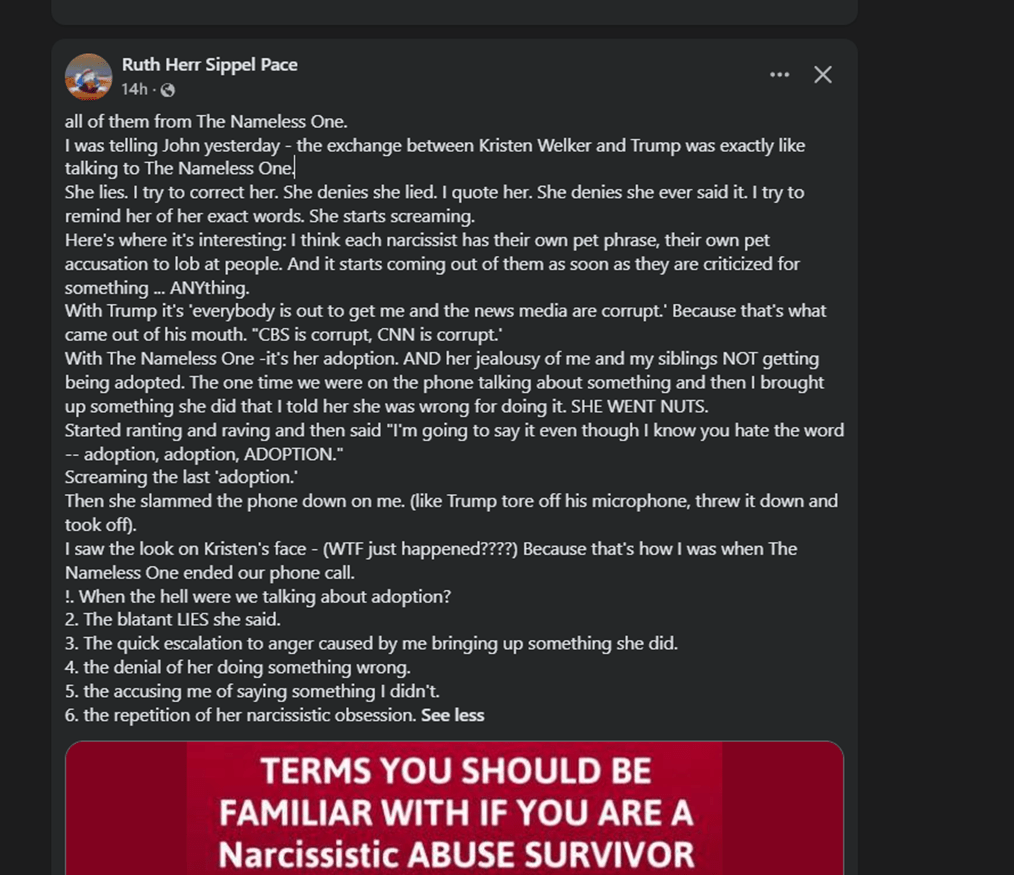
The following are screen shots of my sister’s (RUTH SIPPEL PACE) blog. A friend of mine in another state took these screen shots and emailed them to me.
Screenshot 2026-06-09 134307.jpg
Screenshot 2026-06-09 134233.png
RUTH SIPPEL PACE goes by the name RUTH HERR SIPPEL PACE.
We have not seen each since our father’s illness and open-heart surgery in 2004 and our brother’s funeral in Sept 2003.
I cut all ties with my sisters in the late 1980s.
RUTH, and our eldest sister, GERT MCQUEEN, act as if I am harassing them today, but I am not. I am afraid for my life. These two women want me dead! They have threatened me, threatened my adoptive mother when she was alive, and called for me to kill myself. They continually spy on me, accuse me of outrageous things, which I have not done and am not doing today.
I am not safe. Ruth stalks my house and steals my trash to see what information she can dig up. I know this because I saw her car when I threw out stuff when my adoptive mother died in 2011. Ruth drove away as I came out to put another bag at the curb.
Let me back up. In 1974, I answered a phone call from my eldest sister, GERT SIPPEL FINKEN MCQUEEN. I was 18 years old and did not know I had siblings. I was in shock. Our reunion was full of emotion, happiness, and confusion. They – my sisters – took control. They dominated my life.
A few years into reunion, I realized that I got sucked into their dysfunctional lives. I tried to get away, but they kept it up. They continued to harass me, stalk me, and manipulate me. Calling my house when I was married, yelling and screaming to whomever answered the phone – including my young children. My sisters called my adoptive mother on the day of my adoptive father’s death in 1982 to harass her.
I became an activist for adoptees’ civil rights in the 1970s. I wrote articles in the newspaper. My sisters and several members of my extended birth family and extended adoptive family did not approve of my activism. I wrote and self-published a memoir, which they claimed I lied in it about them. No, I did not. I write from my perspective. They don’t like what I wrote. What they did to me is the truth.
I have been hunted since 1974. Even before that. From their point of view, Mom died, baby sister disappeared. They had to find me, so, their hunt began. My disappearance from our family drove them crazy.
Thank you, adoption! Praise the lord! My adoptive parents got the little baby they wanted – at the expense of my father, my siblings, and me.
I cut my crazy sisters out of my life in the 1980s, but they continue to harass me, stalk me, and gossip about me to turn people against me. They even pick fights with other adoptees on online forums.
Ruth and Gert used the legal system to charge me false child abuse accusations when my children were born in 1983 and 1986, and again in the 90s. The case in the 90s was based on the following claim: “My adoptive mother held my children down on the couch as I had sex with my boyfriend in front of them.”
This did not happen, but my mother and I went through months of court dates. My children were interviewed by the police and accompanied us to court. I could have lost my children.
My sisters charged me with other crimes, too, causing me a great deal of stress and fear. They won a few Orders of Protection against me (BASED ON FALSE CHARGES) and I took them to court and won a few Orders of Protection against them, too.
I do not contact my sisters, or any of my relatives, except for the few who have never treated me harshly.
About 18 years ago, my therapist, based on the severity and intensity of the problems my sisters created for me, and print-outs of their letters to me, diagnosed my sisters as “clinically insane”.
Yes, I am in therapy today. (So are millions of people.) I have Complex and Profound PTSD, depression, anxiety, and panic attacks, thanks to my adoption, chaotic reunion in 1974, and constant bullying and harassment from my sisters, and from cousins in my natural mother’s family, and cousins in my adoptive father’s family.
I am not a Narcissistic Psychopath.
I am not on any psych meds.
I have devoted my entire adult life to adoptees’ civil and human rights, as well as the rights of mothers-of-adoption-loss to humane pregnancy and delivery care and the right to parent their birthed children.
I am 100% anti-adoption. What happened to my father in 1956 (targeted by a relative of a married couple who were childless for 18 years – who then became my adoptive parents), and what happened to me, and what happened to my siblings when they were ages 3, 6, 8, and 9 when I disappeared from our family, should never have happened.
Today, if a pregnant woman is diagnosed with terminal cancer, there is a team of doctors and counselors who take care of the patient, her baby, and her husband and older children. No one would dare tell the father that “the baby needs two parents.” That’s what the stupid Catholic priest said to my father as he stood next to my mother’s open casket.
I stand 100% for Family Preservation. My father did not have any supports to keep me. No round-the-clock infant care for me, no diaper service, no one to help with laundry or food shopping or food prep. I already had a home when I was born to a mother who died from cancer when I was three months old. I did not need a new home. I did not need a new name or a falsified birth certificate. I did not need the trauma that adoption created for me.
Today, Gert and Ruth keep up their spying on me, even to the point of spying on me when I do a book signing with my fellow author friends. I have screen-shots from last year, Nov 2025. (That may be another blog post)
But their recent blog post (June 2026) about narcissistic psychopaths proves that they are the problem, not me.
Ruth highlights a conversation she and I had sometime in the late 1970s or the 80s. My sisters hounded me, screaming at me that I should stop writing about adoption, so I screamed back. This is the phone conversation Ruth is talking about in her June 2026 blog post. She writes in the present tense, making it seem that I am actively engaging in dialogue with her and Gert in the present day.
NOPE!
I HAVE NO CONTACT WITH THESE WOMEN AT ALL!
WHAT THEY ARE DOING IS KEEPING THEMSELVES IN A FRENZY, REHASHING THE PAST, OBSESSING ABOUT ME, MAKING ME SEEM LIKE A NUTCASE.
I am not a narcissistic psychopath as my sisters say that I am. They’ve harped on this kick for decades now. And to compare me with Trump???
I despise that freak of a man. I did not vote for him.
I am living my life as best as I can with my friends, a few loving relatives, and fellow writers and authors, and my musician friends.
I am not harassing my sisters. They are harassing and bullying me. They hunt me on social media, even though I have blocked them.
I repeat:
My sisters RUTH HERR SIPPEL PACE (Buffalo, New York), GERTRUDE SIPPEL FINKEN MCQUEEN (Watertown, New York), and KATHY SIPPEL INGLIS (Liverpool, England), are the perpetrators of bullying and harassment to me.
They rile up our cousins, who then get mad at me, over nothing.
Our cousin, NANCY HERR TRYJANKOWSKI dared to private message me on Facebook, threatening me in November 2025. I then blocked her (we were never friends on Facebook) as I have not seen nor spoken to her – no contact whatsoever – for decades.
None of these people are adopted. What I do does not involve them.
This is to cousin NANCY HERR TRYJANKOWSKI:
Do not threaten me. Do not tell me not write about your father or you will take me to court. Your father was my godfather. He is dead. I can write about him and use his full real name because he is dead. I do not need your permission to write about private conversations between my godfather and me. The law is on my side. Stop bullying me and harassing me. Stay the hell away from me – all of you!
Small Bits of African DNA in My White European Genome
“Trace Ancestry”
In 2014, I learned that I had “0.4% trace ancestry”.
About two years later, after more people tested their DNA, the database grew, which allowed for the identification of specific regions where specific ethnicities lived. My “trace ancestry” became Nigerian. I shook my head in disbelief. Which one of my known ancestors contributed African DNA to my genome?
My first thought was American slavery, but with what I had researched of my family history, slavery did not seem right. None of my ancestors, not even in colonial times, were involved in the Trans-Atlantic Slave Trade. Living up North in Buffalo, New York, near the Canadian border, I thought I was as far away from slavery as possible. I tried to convince myself there were no enslaved people in my lineage.
I felt repulsed by slavery when I learned about it in high school and college. As college students, we watched the 1977 TV miniseries Roots, based on the book by Alex Haley, in the dorm’s lounge. I watched one episode at home with my parents.
In 1984, for the 100-year-anniversary of the publication of Mark Twain’s 1894 novel Pudd’nhead Wilson, a film adaptation of the book aired on PBS, American Public Broadcasting System. Both of these films gave me a sense of the suffering endured by enslaved people in my country’s past.
But how did American Slavery in the United States fit into my ancestry?
Could I be jumping to conclusions? Maybe there were couples who met and fell in love. Maybe this is not as bad as it seems.
I simply put it in the back of my mind to research my African ancestry sometime in the future.
Updated DNA Results
The future arrived in July 2022 when 23andMe.com offered an upgrade chip for a more detailed ethnicity analysis. I paid for the upgrade. The results were posted to my online account in August of 2022, but I did not retrieve the information until October and did not fully comprehend the new breakdowns until January 2023.
My updated DNA analysis tweaked my previously known Germanic, French, Polish, Russian, Ukrainian, Scots-Irish, and English percentages, and revealed previously undetected ethnicities from the Southern European peninsula of Iberia:
3.8% Spanish and Portuguese
The next surprise was more of a shock. My previously detected sub-Saharan 0.4% Nigerian ancestry disappeared. Four smaller distinct ethnic ancestries were present in my DNA:
0.2% unassigned (unidentified)
0.3% Levantine
coastal Mediterranean Middle East:
Lebanon, Syria, Israel, Jordan, Palestine
0.3% North African, along the Mediterranean coast:
Morocco, Libya, Tunisia, Algeria
North African people are a mixture of southern European, Western Asian, and Sub-Saharan ancestry, with genetics from Arabs and 16th-century peoples of the Ottoman Empire.
0.2% Senegambian and Guinean
West African: Senegal, The Gambia, Guinea, Guinea-Bissau
The Mandinka people live in The Gambia along the Niger River basin.
The Wolof people live in Senegal.
The Fulani people live in Guinea and Guinea-Bissau. They have genetic links to North Africa and western Asia (The Levant).
These four small percentages add up to 1.0% and represent the first time an individual entered my genome from a particular ethnicity. These small percentages most likely existed in one person whose parents were a mix of these four ethnicities.
I Have Been White All of My Life – I Do Not Know How to be Part African
This is an unexpected, disorienting, shock. I have been white all of my life. I do not know how to be part African. What is the best way to talk about this? Do I say I am mixed race? But there’s no genetic basis for socially constructed racial categories.
When I stumble with my words sharing this news, most white people are positive. Some reciprocate with stories of their own unexpected DNA results from Africa or Western Asia that changed their perspective of their own diverse ethnic background. Mixed-race people and interracial couples are delighted. Black women and men smile brightly as they raise a hand giving me welcoming fist bumps. One black woman said with a smile, “Hi Sis!”
A few people see my fear of rejection. They comfort me with words of kindness, “Don’t worry what others think. If they reject you, you don’t need them anyway!”
Other people are dismissive. One smug white woman flippantly replied, “We ALL came from Africa thousands of years ago.”
Some people are angry. Others go straight into public shaming.
Public Shaming
On January 22, 2023, I attended a live, national, online Zoom hour-long discussion on race with about 60 people. It was a follow-up to an in-person, day-long seminar in Buffalo, New York on November 5, 2022, with Robin DiAngelo, author of White Fragility: Why It’s So Hard for White People to Talk About Racism, and Nanette Massey, a local African American lecturer on diversity, equity, and inclusion. DiAngelo and Massey were together again, on Zoom, on a chilly Sunday afternoon for a follow-up meeting titled “Ask Me Anything”.
Three hours prior to the meeting, Massey sent out an email to paid registered participants asking us to send in our questions for review. In her opening remarks, Massey told the attendees that she and DiAngelo chose a specific emailed question to begin the session. The way she avoided stating the topic outright and the tension in her voice, I knew my topic hit a nerve. She signaled for DiAngelo to take the lead.
DiAngelo announced the subject of the first email was a white person discovering small percentages of African DNA in their genome. She said she would not call out the name of the person who submitted the question, but if that person wanted to identify herself, she could.
She was clearly baiting me.
I sat in silent horror. My anxiety levels rose as she glared at me through her computer’s camera. Within seconds, I was in a full-blown PTSD response, frozen in place with my heart pounding and blood pressure rising. I sat very still, aware that 60 people saw my face. I took in a deep breath.
DiAngelo authoritatively snapped at me, “You’re not bi-racial. The percentages of African DNA in your genome are so small; it’s minuscule and not relevant.”
I felt red-hot anger at her insult and the assumption that I committed a grave offense against black people. Neither one of these women understood my question.
What harm did I cause by asking what terms should I use to talk about this? If they had opened up the discussion to the rest of the participants, these women might have heard other white people share their DNA revelations, too. They singled me out for committing a perceived offense. I soon witnessed I would not be the only white person harassed by these co-facilitators.
What followed next were harsher condemnations directed at other attendees who they grilled to admit their racism. DiAngelo and Massey lectured to, demeaned, yelled at, and told us we must fess up to our racism and pledge to be “less racist.” Nanette Massey sharply warned us white people to “show up, shut up, receive and affirm, listen and validate” what blacks have to say, yet, it was clear that neither Massey nor DiAngelo showed the same courtesy to the white participants. We were already committed to work for improved race relationships; otherwise, we would not have signed up. It was their intention to make us feel guilty for being born white and raised in a culture of racism.
They Missed My Point Entirely
Maybe these women thought that I was bragging about my less than 1.0% African DNA, carrying it around like a badge of honor or trophy. Maybe they thought I wanted to be seen as African American so I could start acting black and talking black and wearing my hair in cornrows. Maybe these women thought I was using my DNA as a status symbol to gain street cred, or I wanted reparation money.
They missed my point entirely. I do not want street cred. I am not bragging. I am not wearing my African DNA as a badge, trophy, or status symbol. I am not changing my personality to act and talk black or wear my hair in cornrows. I do not want reparation money. I will not be checking the African American box for my race on questionnaires. I am not applying for scholarships under my newly discovered African ancestry. And I’m not wearing Black Face.
I am Naming, Claiming, and Owning Precisely What’s in My DNA
On the contrary, I am naming, claiming, and owning precisely what is in my DNA. Because it is there, in my genome, I am part West African and North African. I am bi-racial. I am part Spanish and part Portuguese. I am part Middle Eastern. No amount of indignant reaction directed at me will change these facts.
These two women do not want me to talk about the small percentages of North African and West African DNA in my genome. Why not?
Dr. Henry Louis Gates Jr. calmly and compassionately addresses hidden African DNA with his white guests on his PBS TV (Public Broadcasting System Television) show Finding Your Roots. Dr. Gates encourages open and honest discussion about white people learning that they have African DNA in their genome. He says, (I am paraphrasing): “The percentage number of 1.0% or less of African DNA is very significant. This DNA came from one person, the one person who brought African ethnicity into your genome. How does this make you feel?”
Unlike some white people who are not ready to accept what is in their DNA, I am facing ugly truths as to why African DNA is in my European white genome.
Read Up on DiAngelo Before Attending Her Workshops
When I read online reviews of DiAngelo’s two books, I read many scathing reviews of DiAngelo’s book, White Fragility, and its sequel, Nice Racism, and of her seminars.
One of the reviewers explained a term I had not heard of before.
This reviewer initially praised the book White Fragility for naming the racist behaviors white people do to black people, but then, the reviewer pointed out major flaws in DiAngelo’s thinking. She said that Robin DiAngelo does not explain the differences between ADOS – American Descendants of Slavery and BIPOC – Bi-Racial People of Color – who are recent immigrants to America [or BIPOC-adopted people who were brought to America by their adoptive parents]. By lumping these two groups of people together, DiAngelo completely erases the specific American history that resulted in the social and economic conditions of oppression and discrimination experienced by ADOS blacks in America today. Their enslaved ancestors have been in America for 200 to 400 years. BIPOC people do not experience the same racism that ADOS black people experience.
If I had done my internet research homework on Robin DiAngelo’s negative reputation (for verbally attacking white people to force them to admit they are racist), I would never have bought her book, White Fragility: Why It’s So Hard for White People to Talk About Racism. Nor would I have paid to attend her first seminar ($40), nor paid to attend the follow-up Zoom discussion ($5).
To her credit, DiAngelo initially does a great job engaging her audiences with a 6-hour presentation based on her book. She co-led the seminar I attended in November 2022 in Buffalo, New York with Nanette Massey, a Diversity, Equity, and Inclusion workshop facilitator. Both women engaged participants in lively, thoughtful dialogue with introspective exercises, all the while using humor. At the end, they posed for photos with participants. DiAngelo chatted with fans and signed her books.
These are the hooks used to lure unsuspecting progressive white people into her further seminars, with admission fees, of course. Nanette Massey organized these workshops in Buffalo. DiAngelo travels around the country, with her workshops hosted by other diversity co-facilitators.
Once you have bought into the “cult” (as author John McWhorter calls it and I agree), it is in the follow-up session that the niceties disappear, revealing the cult leader’s real intention – with or without a secondary co-facilitator. Once they have you seated in the second session, these women grill participants as to what we learned from the first 6-hour session. They demand to know what racist slights we have committed in the recent and distant past, and what we are doing today that is racist. They go into an attack mode not seen in the first session.
I have witnessed with my own eyes and ears the vicious verbal attacks, demanding answers, and yelling at participants to admit their racist actions. I certainly will not give Robin DiAngelo or Nanette Massey a second chance to humiliate me publically for telling me I am racist when I ask a sincere question. I do not want to witness them barrage others into submission.
My advice to rational thinkers is to read the reviews posted on Amazon for DiAngelo’s books, and other outlets online, and read the many critical essays of not only the books White Fragility, and Nice Racism, but spot-on assessments of Robin DiAngelo herself.
Watch Out for Nanette Massey, Too
I may be Nanette Massey’s first public critic, as I have not found any published critical essays of her work.
At the end of her 6-hour seminar with Robin DiAngelo in November 2022 in Buffalo, New York, I asked Nanette how she learned to give these workshops, and what her credentials were. Instead of answering, like anyone who has just given a presentation should be open to answering such questions, she sat there with a tight, forced smile on her face, rolling her eyes at me. Her evasive refusal to answer my question is a misguided response to her message to white people: “Don’t ask blacks to answer your questions because we aren’t responsible for educating you”.
Okay, from a race perspective, I can see that point. Black people do not have to explain race issues to white people.
However, that was not my question to her. I had not heard of diversity, equity, and inclusion workshops until that day, so I was genuinely interested as to the training needed to conduct these workshops. My intention was not to insult her. Nanette certainly does not know how to return professional courtesy. She does not give common decency to session participants.
I am a social worker by profession and had a professional interest in Nanette’s training. Over the years, I have been to many trainings outside of college: teens acting out, teen pregnancy and parenting, mental health, suicide prevention counseling, homelessness, food insecurity, adoption psychology, adoption laws, and adoption reform. With my experiences as both a conference attendee and a presenter at adoption reform conferences and seminars for adoptees, natural parents, adoptive parents, social workers, and psychologists, I am familiar with open questions and answers between presenters and attendees, sharing our life experiences, educational backgrounds, and qualifications. People who attend adoption reform conferences come in all different sizes, shapes, ethnicities, races, and income brackets. We treat each other with respect by answering questions without racial indignation.
Nanette’s silent treatment with eye rolls and staring back at me with a smirk on her face leaves me to read her mind as if I should automatically know what I “did wrong”. She gave me the impression that she is conceited and misguided. Instead of hearing what I asked her, she immediately blocked out the context of my words. She was insulted that I dared ask her a question and refused to treat me like a human being. Nanette saw me as a white woman and not as a person.
Yet, that is exactly what she demands of white people: “Just to talk to blacks like we are people because we are people”, she said in an angry tone of voice to her audience. Massey’s indignant response to my simple question tells me she cannot talk to white people as equal human beings to her. This game-playing behavior does nothing to advance communication or improve race relations. Her attitude makes the situation worse.
The same goes for Robin DiAngelo.
Follow-Up Workshops Are Aggressive and Hostile
The format of the follow-up session titled “Ask Me Anything” was non-productive to improve race relations. It was aggressive and hostile. What is the point of organizing a follow-up session in which the leaders badger and belittle participants for asking reasonable questions? If the point is for white people to learn, then why harass us when we ask intelligent questions?
I do not recommend reading White Fragility, or Nice Racism, nor do I recommend attending DiAngelo’s and Massey’s workshops.
Stay safe. Stay sane. Stay away – from these women.
Looking back now, I think DiAngelo and Massey confuse themselves with their own negative thought loop. If their goals are to instruct white people to be “less racist” to ultimately eliminate racism from American culture, they need a different approach.
Native American Approach to Instructions on Racism
For a very different methodology and antidote to racism, I have been to presentations on The Doctrine of Discovery and Manifest Destiny given by Native Americans at the Center for Inquiry in Amherst, New York, and the Unitarian Universalist Church of Amherst. The presenters’ approach to largely white audiences was more respectful, honest, and egalitarian than the two workshops I attended by DiAngelo and Massey.
The Native American speakers were aware that their presentation would address sensitive matters that could trigger shame and guilt in their non-Native audience. They were quick to say before, during, and after their presentations that the material addressed the past as well as the present but was not an attack to make non-Native people feel guilty or stressed in any way. The purpose was to educate, to inform, not to attack. As a result, the audience was receptive to critical thought and discussion of how history affects the present. We learned how policy affects Native peoples, which leads to prejudice and discrimination. The presenters did not verbally attack white people in the audience. As a result, while it was hard not to feel guilty about the racism that our ancestors perpetrated, white people were not made to feel we carried the blame. We were not required to examine our own behaviors in the past or in the present. We felt better about ourselves. By the end of the presentation, we all had the sense that we could work together for positive change.
The Most Likely Scenario
This is my maternal line leading down to my great-grandmother, grandmother, my mother, and to me:
Between 300 to 500 years ago, a Portuguese slave trader forcibly kidnapped my African ancestor from her homeland and transported her to Portugal. She was raped and impregnated. Her daughter and granddaughter met the same fate.
When Portugal abolished slavery in 1761, my mixed-race maternal ancestor was sold to a Spanish slave trader who then raped her and fathered a daughter with her. That daughter had a daughter who met the same fate. At some point before Spain abolished slavery in 1869, a Spanish slave owner freed my female ancestor. She moved to France where my 3rd great-grandmother was born. She married a French man (I know this by her surname). In 1854, this couple had a daughter – my 2nd great-grandmother. She was born 36 years after France abolished slavery in 1818. My 2nd great-grandmother married a German man. They immigrated to America in 1870, and settled in Rochester, New York, before moving to Lockport where they had my great-grandmother. She gave birth to my grandmother in Buffalo, New York. My mother was also born in Buffalo. She had five children. I was her youngest. Mom died. And Dad was talked into giving me up for adoption.
I am a descendant of the Trans-Atlantic African Slave Trade that took place in Portugal and Spain. If my 2nd great-grandmother continued to live in France, she and her descendants would be African Portuguese and African Spanish, or African Hispanic. This is an important distinction. Though I live in Western New York State, in the United States, I do not descend from American slavery, so I am not part African American, Latin American, or Hispanic American.
It is not easy to come to terms with this most probable history. This horrible history is an educated guess. To borrow a phrase from a fellow writer who is Native American and White: I am a descendant of both the Oppressor and the Oppressed.
I may never know the names of the generations of mothers and daughters who endured sexual slavery, or the names of the Spanish and Portuguese men who impregnated these girls and women, but these ancestors left their DNA in my genome.
My goal is to investigate this as thoroughly as I can. I would like to find five, six, or seven generations of marriages between loving couples who were mixed-race couples living along the Mediterranean Sea coast, however, this doesn’t explain how West African DNA mixed in with the rest. The historical evidence points to the Trans-Atlantic Slave Trade in Portugal and Spain. If I cannot locate historical documents to prove my theory or show marriages instead, then all I have is DNA and a great deal of speculation. This DNA gave me my brown eyes, frizzy brown hair, blood type, and unknown inherited characteristics. This is not minuscule nor irrelevant.
References
“White fragility is real. But ‘White Fragility’ is flawed.”, Carlos Lozada, The Washington Post, June 18, 2020
“Our Endless Dinner With Robin DiAngelo, Suburban America’s self-proclaimed racial oracle returns with a monumentally oblivious sequel to “White Fragility””, Matt Taibbi, Racket News, June 30, 2021.
Article by CHARLIE CAMOSY who interviewed Elizabeth Kirk. She is the director of the Center for Law and the Human Person at the Catholic University Columbus School of Law, where she also teaches family law. She is an associate scholar at the Charlotte Lozier Institute.
October 7, 2022.
See the link above to read the full article.
…
In response, I wrote my comments in five parts. I signed up for a free registration to the above link to comment.
I expect my comments will be deleted because no one really wants to hear the truth about adoption. The buyers do not want to hear from the product. So, I posted all of my comments here as a back-up, and at the above link as comments at The Adopted Ones Blog.
Part 1
Because society views all adopted people as perpetual children, some adopted adults refer to themselves as “an adopted child”. In this article, Elizabeth, calls herself “an adopted child,” even though she is an adult. “Adopted child” rolls off the tongue easily. One really has to think before speaking, especially about adoption. The correct term is “adult adoptee”. Or, to be more specific, Elizabeth Kirk could say “I was adopted by my step-father when I was a child.”
Elizabeth doesn’t mention anything at all about her biological father. He sired her so he is her father, even though she doesn’t want to admit this fact of her life. Sure, she loves her step-father-turned-adopted-father. I love my adoptive father, too, but to ignore the facts of life is to ignore life itself.
Every single one of us was sired by a father, gestated inside our mother, and birthed by our mother. These are facts.
Adoption is a legal transaction that does not replace birth. These are facts.
And yet, for every single adoption – including the adoption of step-children – the adopted person’s birth certificate is revoked, sealed, and replaced by a false-fact birth certificate that replaces the adoptee’s name of birth with the new name of adoption, and replaces the names of the natural parents with the names of the adoptive parents. This gives the impression that these people gave birth to the re-named child.
This is a denial of the facts of life.
This is lying.
Lying is a sin.
Part 2
Catholics promote advertising through websites that they want to adopt “your baby”. This is trolling for vulnerable women to give up their babies to the possession of adopters to avoid abortion. This is targeting women for their babies. The end result is the destruction of a family for the purpose of owning someone else’s baby. This is also coveting someone else’s baby, which is a sin because coveting someone else’s spouse is a sin.
There is no mention in this article of lifelong trauma imposed on the mothers who relinquish their infants to adoption. And no mention of the fathers, as if they aren’t important. And, conveniently, no mention of ACEs – Adverse Childhood Experiences.
Why would anyone willingly inflict stressful and traumatizing events on a newborn? Babies feel pre-verbal loss of mother as all-encompassing body and brain trauma. The child grows up in fear, yet doesn’t know why there is lingering anxiety and panic, or unexplained illnesses. The infant given away at birth or as an older baby or as a young child feels this as abandonment, even when adopted by parental care givers who love this child. Adverse Childhood Experiences develop into medical issues or mental health issues later in life. This trauma is also passed down to the adopted person’s children through a process that changes gene expression: epigenetics.
Why would you intentionally cause life-long emotional trauma on babies and children? Why would you want to cause emotional pain for natural mothers and fathers? Or our siblings?
Part 3
I was born the 5th child to married parents in 1956. My mother died of cancer when I was three months old. A Catholic priest told my father that “the baby needs two parents.” Neither the priest, nor Catholic Charities, offered help to my father to keep our family together. No offering of food, clothes, diapers, child care, or respite care for my father who had to go to work while his older children were in school.
This is not being Christian.
No one in their right mind today would tell a father of a newborn and four older children under the age of 9 to give up his newborn daughter to adoption.
Thirty years after meeting my natural father for the first time, he was recovering from open heart surgery. He sat in a wheel chair when I walked in to his room in a nursing home. He cried, “If someone would have told me what would happen to you, if someone would have told me how to keep you…”
I knelt down in front of him, took his hands in mine, and said, “I never held it against you, Dad. You were in an impossible situation. You were used.”
I loved my natural father, and my natural mother. I also loved my adoptive parents.
The ugliness of adoption is there and must be dealt with. This is a burden I wouldn’t inflict on anyone.
Part 4
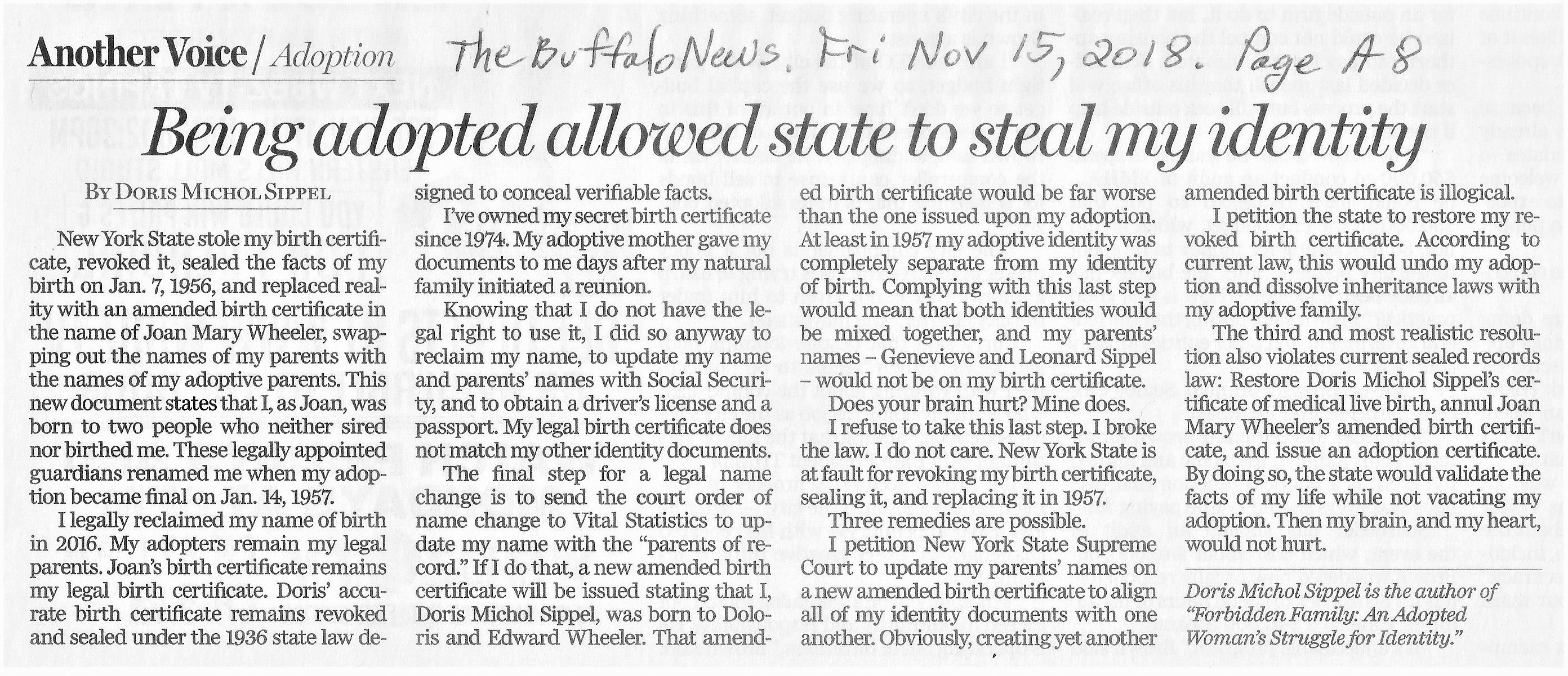
In 1956, my name at birth and (Catholic) baptism was Doris Michol Sippel. I carried that name and birth certificate for the first 15 months of my life. I was legally adopted at age of one year and one week, but my birth certificate remained intact for another three months. My Original Birth Certificate was then replaced with a new birth certificate that stated I was born as Joan Mary Wheeler. My natural parents’ names were swapped out and replaced by the names of my adoptive parents, as if they had sired me and birthed me.
In 1959, my adoptive parents asked their lawyer to contact the church in which I was baptized to have a new baptismal certificate issued in my adopted name of Joan Mary Wheeler. The priest wrote up a new baptismal certificate with my new name and the names of my adoptive parents, as if my actual baptism didn’t take place.
The priest lied.
The State Bureau of Vital Statistics lied.
My Catholic adoptive parents lied.
Lying is a sin.
My baptismal certificate was falsified to show proof that I was baptized so that my adoptive parents could send me to Catholic schools.
According to Cannon law, a person can be baptized only once. So, to have a 2nd baptismal certificate in my legal name of Joan Wheeler is morally wrong. I was baptized in the name of Doris Michol Sippel in the eyes of their god. Joan Wheeler was never baptized, yet her baptismal certificate says she was baptized as Joan Wheeler. That is not true.
My Original Birth Certificate was revoked, sealed forever, and replaced by a false-fact birth certificate created so that my adopters could say I was their child. I was their adopted daughter. They were not responsible for siring me, gestating me, nor birthing me. Their names did not, and do not now, belong on my birth certificate. Their names are on the court order of adoption, which is the truth.
It is morally wrong for anyone to claim on a government-issued birth certificate that they sired, gestated, and gave birth to a child when they didn’t. This ought to be illegal – to lie on an official birth certificate. But, in adoption, since the 1930s, it is perfectly legal to lie on a government-issued birth certificate.
This law must change. Adopted people have the moral, ethical, and human right to the truth of our births. We should have the legal right to one – and only one – birth certificate like all non-adopted people.
Are you paying attention, Elizabeth Kirk? You call yourself a lawyer in family law? Do you really understand adoption and vital statistics laws?
I don’t think you do.
Part 5
I legally reclaimed my name in 2016. But my legal birth certificate remained in the name of Joan Wheeler. Why? Because the final step to changing one’s name requires the State Dept. of Vital Statistics to place the new legal name on a new amended birth certificate with the names of the “parents of record”, which, in my case, my “parents of record” were my adoptive parents. I certainly did not want a new, amended, birth certificate stating that my adopters, Edward and Doloris Wheler, gave birth to me as Doris Sippel!
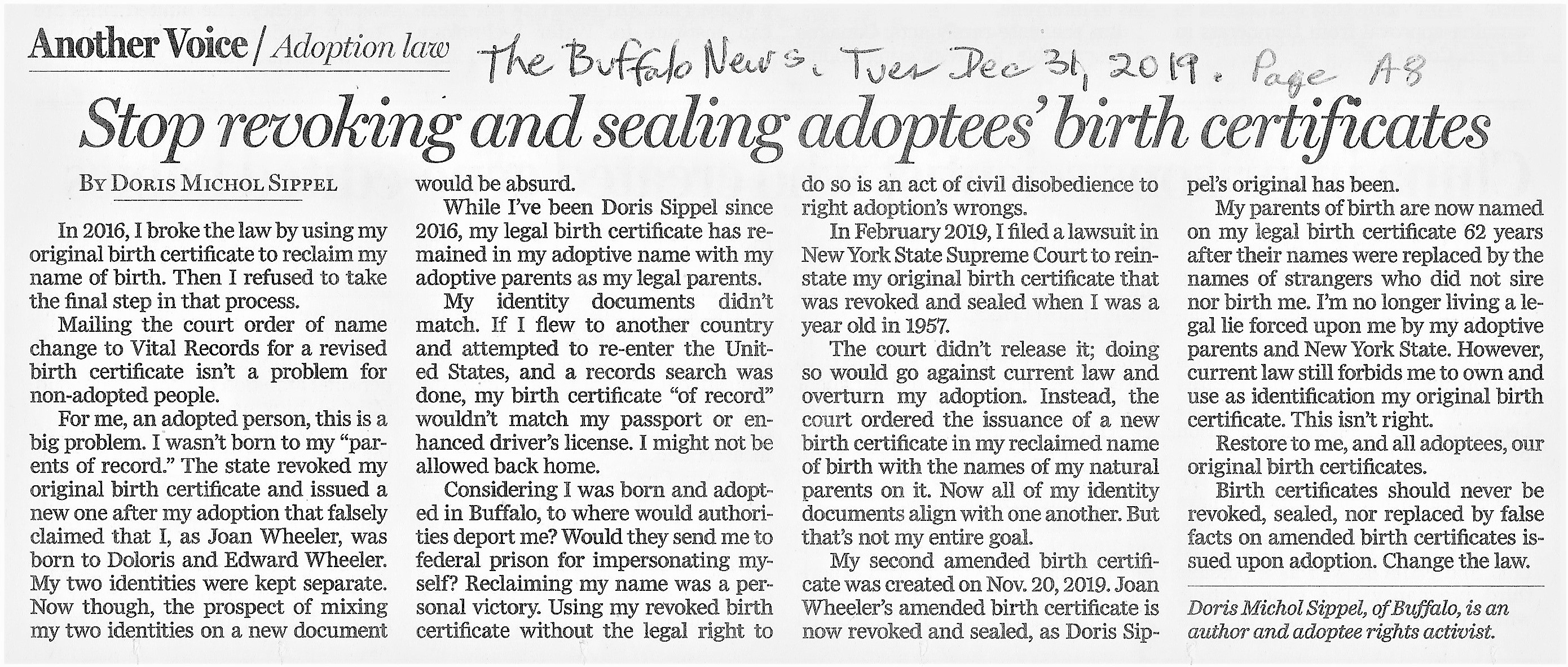
In 2019, I sued New York State and won a partial victory. I won the right to replace the names of my adopters with the names of my natural parents on a new legal birth certificate. My Original Birth Certificate is still revoked and sealed. The court order of adoption still stands as proof of my adoption.
Adoption is child abuse by forced separation at birth from mother, and father, siblings, extended family, family history and culture. Adoption is identity theft. Adoption is unnecessary lifelong trauma for both mothers and their infants. Family preservation, kinship care, and legal custodial guardianship provide legal protections for the child who truly needs a home.
I’m sure you’ll delete my comments here.
But don’t worry. I posted my comments on my blog with a link to your blog post calling for the inhumane removal of infants from their mothers at birth.
Stop inflicting your beliefs onto other people. A woman’s body is hers and not yours. Whatever she decides to do with her pregnancy is none of your business.
Buffalo is The City of Good Neighbors. We take care of each other. Yes, we do have problems, but for the most part, we are a community of love and caring. We are grieving and outraged at the racial violence and murder perpetrated by one evil young man against our Black community on Sat May 14, 2022.
I’ve lived in a northern suburb of Buffalo since my adoption in 1956. The area targeted by the gunman on Sat May 14th is a very old community and close to my heart.
The two photos I posted here will give you an idea of my personal history. In the black and white photo, taken in 1946, you can see my future adoptive mother, Doloris Cannell Wheeler, on the right. Her father, Louis Cannell, stands in the middle, and his second wife, Rose, is on the left. They are both from Italy. This photo was taken in my grandparents’ front yard at 568 Jefferson Ave, Buffalo, NY; their house isn’t in this picture. It was torn down years later and replaced by new housing. The brick building across the street is 563 Jefferson.
This morning, May 16, 2022, I took the color screenshot of the same brick building. Note the renovated house next to it on the left is the same house in the background in the black and white photo.
TOPS Market, where the massacre occurred Sat May 14, 2022, is further up north at 1275 Jefferson. One block south of the location in this photo is Broadway. In 1956, when I was born, my natural parents lived a few blocks East up Broadway on Smith Street. My adoptive parents lived on Coit Street, one block over and three blocks down from my natural parents. After my mother died, my father relinquished me to my adoptive parents. Nine months later, we moved less than ten miles away from my natural father.
In the 1940s and 1950s, this area, Buffalo’s East Side, was home to Italian, German, and Polish immigrants, and African Americans who moved up North from the American South. Irish immigrants settled in South Buffalo, Jews in North Buffalo, and Native Americans were scattered in the inner city and several reservations to the south and north of Buffalo.
By the 1960s and 1970s, Buffalo became home to over 100 ethnic immigrant groups, with people from all over the world. We continue to be a vibrant community.
When I was a teenager, I was a Native American dancer. No, I’m not Native, but my high school friend invited me to join her family in this cultural dance group. We participated in annual Ethnic Heritage Festivals. Two to four groups performed dances every Sunday for 6 months. At the end of those 6 months, we’d have a three-day celebration of ethnic food, dance, and cultural displays at the Buffalo Convention Center. For some reason, this large event hasn’t happened in the last 30 years. However, we continue to host a variety of cultural programs throughout the year.
Yes, Buffalo has problems. We struggle like other cities do, but we organize to help each other. It is possible for love and peace to prevail. We need to find solutions to grow a peaceful world.
My Adoptive Mother and Her Parents, 1946, on Jefferson Ave, Buffalo, New YorkGoogle Screen Shot of the same red brick building today May 16, 2022
…
Funerals are starting. We need to have difficult conversations. We need to make sure a mass shooting targeting blacks or Jews or Asians never happens again. Educate against racism and intolerance. Put a stop to ignorance.
This is a re-blog by a Mom who voluntarily gave up her parental rights to her infant to “give her a better life”. That’s the catch-phrase society uses to lure vulnerable young mothers into believing they aren’t good enough to parent their own child.
What impresses me here is not only the Mom’s courage to identify the male adopter and to call him out on his bad behavior, but the young adult adoptee’s maturity and grace.
This is yet one more example that adoption is not at all what unaware people think it is.
For those who asked, here is THE ADOPTION PRIMER. You can copy and paste these two pages onto your own Word document and print on double-sided paper. Fold into a tri-fold pamphlet.
This is an educational tool to instruct people who are not aware of adoption’s Identity Theft about Original Birth Certificates (OBC) and Amended Birth Certificates (ABC).
I’ve used my own OBC and ABC in this printable pamphlet.
I’ve also included a text-based format below for people who want to see the print flow.
Now, let’s educate people on Adoption’s Identity Theft!
The Adoption Primer
What You Need To Know About Adoption’s Identity Theft, Restoring Adoptees’ Birthrights, and Critical Adoption Studies
Many Westernized countries have similar laws to the United States. When an adoption is finalized in court, the adoptee’s Original Birth Certificate (OBC) is revoked, sealed, and replaced with an Amended Birth Certificate (ABC). The court mails the Final Court Order of Adoption to the State’s Office of Vital Records where a new birth certificate is created mixing new information of adoption with the facts of birth. The names of the adopters replace the names of natural parents, erasing them. If the child was named at birth, the birth name is replaced with the new name given by the adopters.
Rewriting the facts of birth — outright lying — on official birth records became law after 1930. Through the passage of time, this has become socially normalized: expected, even demanded, by adopters, then celebrated, “This is my child.”
The stigma of illegitimacy drove legislators (men) to target single mothers and their legally fatherless babies. These children were legally reborn, legitimized, by adoption to a married man who became the legal father.
Before 1930, adoptees had civil rights to keep their birth certificate, even when adoption changed their name. But adopters wanted the adopted name on the birth record to match the family name, making it easier to prove the adoptee was legally adopted. Proof was needed for educational enrollment, medical care, insurance coverage.
Creating new identities for adoptees had the added bonus for adopters of preventing the natural parents from knowing the child’s new name and address; they couldn’t interfere because the child was unknown to them. Many adopters didn’t tell the adoptee they were adopted. The records were sealed; no one needs to know.
All domestic, Native American, and transnational adoptees in the USA are affected. The US Department of State requires the foreign-born child’s birth record replaced with an ABC before that child is allowed to leave their homeland. Sometimes, naturalization wasn’t completed, resulting in in deportation of many foreign-born adoptees as adults.
If adopters no longer want the child they adopted, they rehome the child to someone else. The ABC is revoked, sealed, and replaced with a new ABC issued when the 2nd adoption is finalized.
Today’s Open Adoption is only a social arrangement, adoptees’ OBCs are still revoked, sealed, and replaced. Socially Open Adoption doesn’t equate to Open Records with adoptees’ unrestricted access to the sealed OBC.
When adoptees in closed and sealed adoptions find out their name at birth, many reclaim their names, as I did. Many also want to annul their adoptions due to abuse, adoptive parent pedophilia, or simply want to be un-adopted. But only adopters can annul an adoption. Some adoptees are adopted-back by their natural parents. Many Asian adoptees leave their country of adoption to move back to their homeland, rejecting their removal.
We know there is no need to change the child’s name upon adoption, or to erase the names of the natural parents, or for adopters to pretend to be parents of birth. The Court Order of Adoption is sufficient proof of the legal rights and responsibilities adopters have in their parental roles for the child in their care.
Birth is birth, verifiable through medical records for maternity care, labor, birth, and by DNA. Adoption is a legal transaction handled by a court. These events should be documented separately. But they aren’t.
When women change their surname upon marriage, they don’t lose their birthright. Married women’s birth certificates remain un-revoked, unsealed, and unchanged. When proof of marriage is needed, a marriage license is presented.
We can do this in adoption, too.
In this modern age, it is the ethical right action to respect adoptees for who we were born as and who we were born to. Our births, our origins, are just as important to us as yours are to you. We came from our parents before we came into adoption. Unconditional love from adoptive parents requires acceptance of what is. Lying, covering up, and denying the truth is wrong.
Since I first saw my OBC and ABC in 1974 at my age of 18, I’ve advocated for changing all current State and Federal laws (adopting a child born in another country) mandating revoking, sealing, and amending adoptees’ birth records. These laws must be repealed and replaced.
Every free American citizen should have one, and only one, factual birth certificate, otherwise, we are not free.
Reality-based birth certificates for all adoptees and donor-conceived is my recommendation.
You might also find this article educational about Original Birth Certificates (OBC) and Amended Birth Certifcates (ABC). I present all of my documents here in this post:
THE INTERNATIONAL ADOPTEES RIGHTS MOVEMENT BEGAN IN 1953
ADVOCATING FOR LEGAL ACCESS TO OUR OWN SEALED BIRTH CERTIFICATES
10 USA States passed Unrestrictive Access Laws: Alaska, Kansas, Alabama, Colorado, New Hampshire, Maine, Rhode Island, Oregon, New York (2020), and Connecticut (2021).
21 USA States passed Compromised-Limited-Access Laws: Massachusetts, Vermont, Maryland, New Jersey, Pennsylvania, Ohio, Michigan, Indiana, Wisconsin, Illinois, Iowa, Missouri, Minnesota, Arkansas, Tennessee, Oklahoma, Nebraska, South Dakota, Montana, Washington, Hawaii.
19 USA States Total Restrictions-No Access: Complete Sealed Records, at least no access yet: Washington DC, Virginia, West Virginia, Kentucky, Georgia, North Carolina, South Carolina, Florida, Mississippi, Louisiana, Texas, New Mexico, Arizona, Utah, Wyoming, North Dakota, Idaho, Nevada, California.
…
Our goal is to achieve adoptee equality to non-adopted people.
How would you feel if you were legally forbidden your own birth certificate?
For those people who want to shut us down, tell adoptees how to feel and what to think and how to behave, please, please listen to what adotped people say. Validate our feelings, our experiences.
We don’t have to “be grateful.”
We’re not “angry and bitter” when we speak our truths.
Perhaps you could read this post frm another adopted person’s point of view:
It was the lowest point in my life. I had lost so much in such a short amount of time. I had gone from someone who believed in a hopeful future to someone who was hopeful just to make it through each day; nevermind a future. I was shamed and left unsupported. I had broken social mores and had to be chastised for my deviation. Rebuke would get me back in line and closer to God.
You prayed against me.
You preyed upon me.
You dehumanized me.
You infantilized me.
You judged me.
You convicted me.
You punished me.
You devoured me.
Then you took a piece of me.
You paraded yourself as savior.
You prayed that I would fail. You prayed that I would be alone. You prayed that I would be unsupported. You prayed that I would be resourceless. You prayed that I would be poor. You prayed…
This needs to be read by everyone who believes that adoption is wonderful, and that adoptive parents “save” adoptees from a life of poverty, and that you know many happy adoptees who wouldn’t dare speak out against adoption.









You must be logged in to post a comment.